Your shopping cart is currently empty.

Brass For Beginners: A Conversation with Musician & Educator Chris Hasselbring
|
|
Founded by musician and educator Chris Hasselbring, Brass For Beginners strives to make learning the trumpet a more meaningful and educational experience for students of all ages. By pairing an expertly engineered and user-friendly natural trumpet with a thoughtfully researched curriculum, Brass For Beginners approaches music education in an entirely unique way. Their interdisciplinary pedagogical method engages student's creativity and aural skills, and effectively equips them with the fundamentals necessary to master any modern brass instrument. On a recent call, Chris reflected on the significance of a holistic music education and offered key insights about how to ensure that students become not only talented performers, but truly passionate musicians. Here, Chris chats about his career, his program and signature education philosophy, and more. |
What first inspired you to pursue music education? And what inspired you to pursue a career as a musician and an educator?
My earliest inspiration came from jazz—especially hard bop and cool jazz. I grew up in a small town in Ohio with an unusually strong Middle and High School jazz program, which opened doors to scholarships and opportunities like the Eastman Summer Jazz Camp. At that stage, my background in classical music was still limited, but I went on to earn a full scholarship to study jazz at Rutgers University, where my musical perspective began to expand.
At Rutgers, I studied with William Fielder, a jazz educator with deep classical roots, having worked with legendary Chicago Symphony trumpet players Adolph Herseth and Vincent Cichowicz. Through his mentorship, I was introduced to classical and early music, which fundamentally shaped my development as a musician.
Throughout this entire period—from my student years through my early professional career—I was also consistently teaching private trumpet lessons. That experience became an important parallel path, allowing me to explore how musicians learn while continuing to grow as a performer myself.
I continued my studies at Northwestern University and performed with the Civic Orchestra of Chicago, eventually transitioning into orchestral performance. I held principal trumpet positions with the Orquesta Filarmónica de Bogotá, the Shanghai Symphony Orchestra, and the Singapore Symphony Orchestra, and was notably the first foreign musician to join a Chinese orchestra since the Cultural Revolution. I also performed at international festivals such as the Pacific Music Festival in Japan and toured with the Dallas Brass.
Even during these performing years, teaching remained a constant, and over time it became a more central focus. After returning to Chicago, I began focusing more on teaching while maintaining an active freelance career. It was during this period that I discovered the natural trumpet—an experience that ultimately led me to explore its potential as a powerful pedagogical tool.
What was it about playing the trumpet and classical music that compelled you?
The trumpet initially caught my ear through jazz, where it plays such a central role. Certain jazz trumpeters were a huge inspiration to me early on. That said, I’ve never really thought of the trumpet as my “favorite” instrument—I’ve spent just as much time listening to other instruments, and in many ways I’m just as drawn to them. The trumpet is simply one voice among many in the vast world of instrumental music. What would the trumpet be without the flute or the cello? I’ve often wished I could play them all.
My connection to classical music developed later, and I think it was shaped by coming to it from a jazz background. I’ve heard other jazz musicians describe a similar experience. Jazz is deeply personal and expressive, but when I transitioned into symphonic playing, I discovered a different kind of voice—one that exists within a larger musical landscape.
What really drew me in was the experience of being inside these great works of art and contributing to something bigger than myself. I found a deep sense of fulfillment in supporting the sound around me—helping shape the overall texture, enhancing what others were doing, and using the trumpet not just to project, but to blend and “sing” within the ensemble.
Is there any advice you’d give to students who hope to work as professional musicians?
If music isn’t fundamentally meaningful to you—if you’re pursuing it simply because you’re good at it—it may not feel fulfilling in the long run. Technical skill is important, but it’s only part of making music. I sometimes hear young musicians who play all the right notes, with precision, control, and a strong sense of time, but where the humanity in the sound hasn’t fully come through yet. That human element—the sense of connection—is what ultimately brings music to life.
For me, the most important thing is helping students develop a sense of meaning and connection. The goal isn’t just to improve, but to inspire curiosity, nurture a love of the process, and cultivate a personal voice. Those are the qualities that sustain a lifelong relationship with music—and ultimately, a meaningful career.
It’s clear that Brass For Beginner’s interdisciplinary method stresses those same very fundamentals and passions. How does the use of the natural trumpet factor into that?
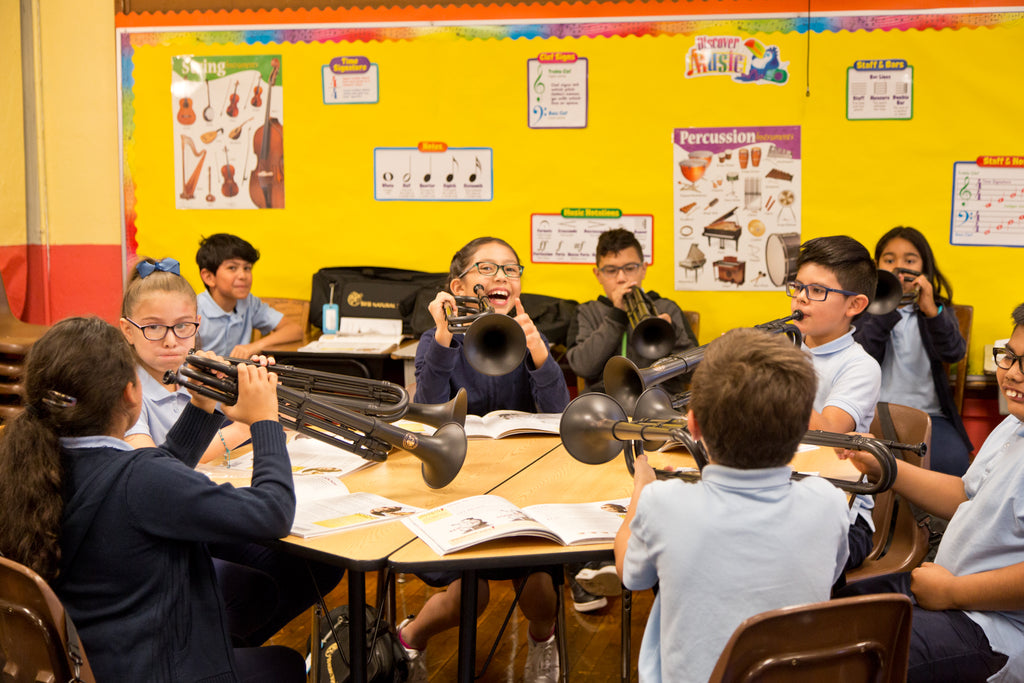
Our approach is to use the natural trumpet as an educational tool for learning the fundamentals that apply to all brass instruments. Through conversations at educational and academic conferences, it became clear to us that the natural trumpet offers something similar to what the recorder provides for woodwinds. Just as the recorder introduces core fundamentals in a simplified way, the natural trumpet—coincidentally, also a historical instrument—offers a clear and accessible entry point into brass playing.
At its core, the natural trumpet strips the instrument down to its most essential elements. That simplicity is incredibly valuable in a classroom setting. While there are colorful plastic versions of modern brass instruments available, they still retain all the same variables as their metal counterparts, which can create significant barriers in a whole-class environment. What we’re offering is an approach that makes whole-class instruction not only possible, but efficient and effective.
By reducing complexity, the natural trumpet allows students to focus on the fundamentals that matter most in the early stages: sound production, articulation, and navigation of the harmonic series. The instrument naturally produces a set of accessible notes in the middle and lower register, all of which form consonant intervals. In other words, all notes that students play at first sound “right,” which allows them to build confidence in sound production while they develop more precise pitch matching skills.
From there, instruction emphasizes posture, breathing, and embouchure development—establishing strong habits from the very beginning. With that foundation in place, students are much better prepared to transition successfully to modern brass instruments.
Ultimately, we use the natural trumpet to introduce these fundamentals to pure beginners of any age, and we pair it with a broader general music curriculum. That combination is especially important, because there hasn’t traditionally been a well-defined general music approach to brass instruction. This allows us to fill that gap in a meaningful way.
BFB’s curriculum includes a focus on the history of the trumpet. Why do you feel that is an important component to learning to play the instrument?
I first started using the natural trumpet with my students at the Music Institute of Chicago (MIC) for its pedagogical benefits, and ultimately that led me to realize it could be a powerful tool for beginners on any brass instrument. We launched pilot programs with support from Kay Mabie and MIC, and for that initial phase I worked with my brother Jack, a music educator in NJ, to formulate a curriculum that looked like a traditional band method, with a short two-page “History of the Lip-Blown Instruments” section at the back.
What surprised me was that students kept flipping to those last pages. They were curious. They started asking questions—big, fundamental ones: Who made the first trumpet sound? How did that happen? Why would someone even think to do that? Those questions led to some of the most engaging moments in the classroom. What began as a small addition quickly became a central part of how students connected to the instrument.
Philosophically, I think that when students understand where something comes from, they relate to it more deeply. It connects to their curiosity about the world—history, culture, and human creativity—and that sense of meaning makes the learning stick.
As those conversations grew, it became clear that this small history section needed to become something much more substantial. That realization naturally led to a collaboration with my wife, historian Dr. Kirsty Montgomery. Together, we developed a curriculum that draws on history, archaeology, geography, religion, and art to explore the origins and development of lip-blown instruments.
The goal is to equip teachers with enough context that when a student asks a question like, “Why were trumpets used on ancient ships?” there’s a real, meaningful answer—one that opens up a broader understanding of the instrument and its role in human history.
That broader engagement is essential. In many traditional classroom settings, a portion of students inevitably disengage. But when you provide multiple entry points—sound, history, storytelling, and cultural context—you give more students a reason to lean in. The instrument matters, but the curriculum surrounding it is often what determines whether students truly connect.
Ultimately, educators need to give students a reason to care. Technique and fundamentals are important, but they mean little without a reason for making sound in the first place. We aim to answer the deeper question: Why does this matter? When students can connect to that, their engagement—and their learning—changes completely.
This seems like a really unique, thoughtful education philosophy.
I’m dedicating my time to getting this program into the hands of educators and students so they can benefit from what this approach offers. A big part of that motivation comes from the fact that I wish I had experienced something like this myself.
I went through college without really understanding how my instrument worked at a fundamental level. I studied with renowned teachers at top institutions—but even in those environments, certain questions weren’t always explored. Sometimes, when teaching becomes too narrowly focused, the most important issues can be overlooked.
I remember working on Brahms’s Symphony No. 1, which reflects the influence of natural trumpet writing. It was explained to me how to transpose passages for trumpet in C, E, and H (German for B natural), which I could do—but I found myself wondering: Why these particular notes? Why is the composer writing for trumpets in different keys? Those were the kinds of questions I was asking, but they weren’t being addressed. If I were teaching that piece, that’s exactly where I would begin.
There’s no reason we can’t offer students a deep, meaningful understanding of music from the very beginning. In fact, I think that’s exactly what they’re looking for. The issue isn’t the complexity of the material—it’s how we present it. Students are naturally curious and capable of engaging with real substance.
I saw this firsthand when I taught at my wife’s independent school, working with students in grades 3–5. It was one of the most rewarding teaching experiences I’ve had, because the students were ready, open, and eager to learn. Too often, we underestimate young learners or treat them as if they can’t handle complexity, and that’s when they disengage.
In reality, they’re thoughtful, perceptive, and curious. One of our core beliefs is simple: never underestimate children. When you meet them at that level, they can rise to it—and flourish.
On April 11th, you participated in ‘Brass for All: Empowering Every Teacher, Engaging Every Student’ at PM Music Center. Can you share a bit about these types of events?
The event is a hands-on introduction to how the natural trumpet can bring accessible, whole-class brass instruction into the general music classroom. Instruments will be provided, and attendees will actively participate—essentially stepping into the role of students to experience how the program works in practice.
We demonstrate how the use of the natural trumpet allows teachers to focus on core fundamentals while making music right away, and how an interdisciplinary approach—connecting sound with history and culture—can deepen student engagement.
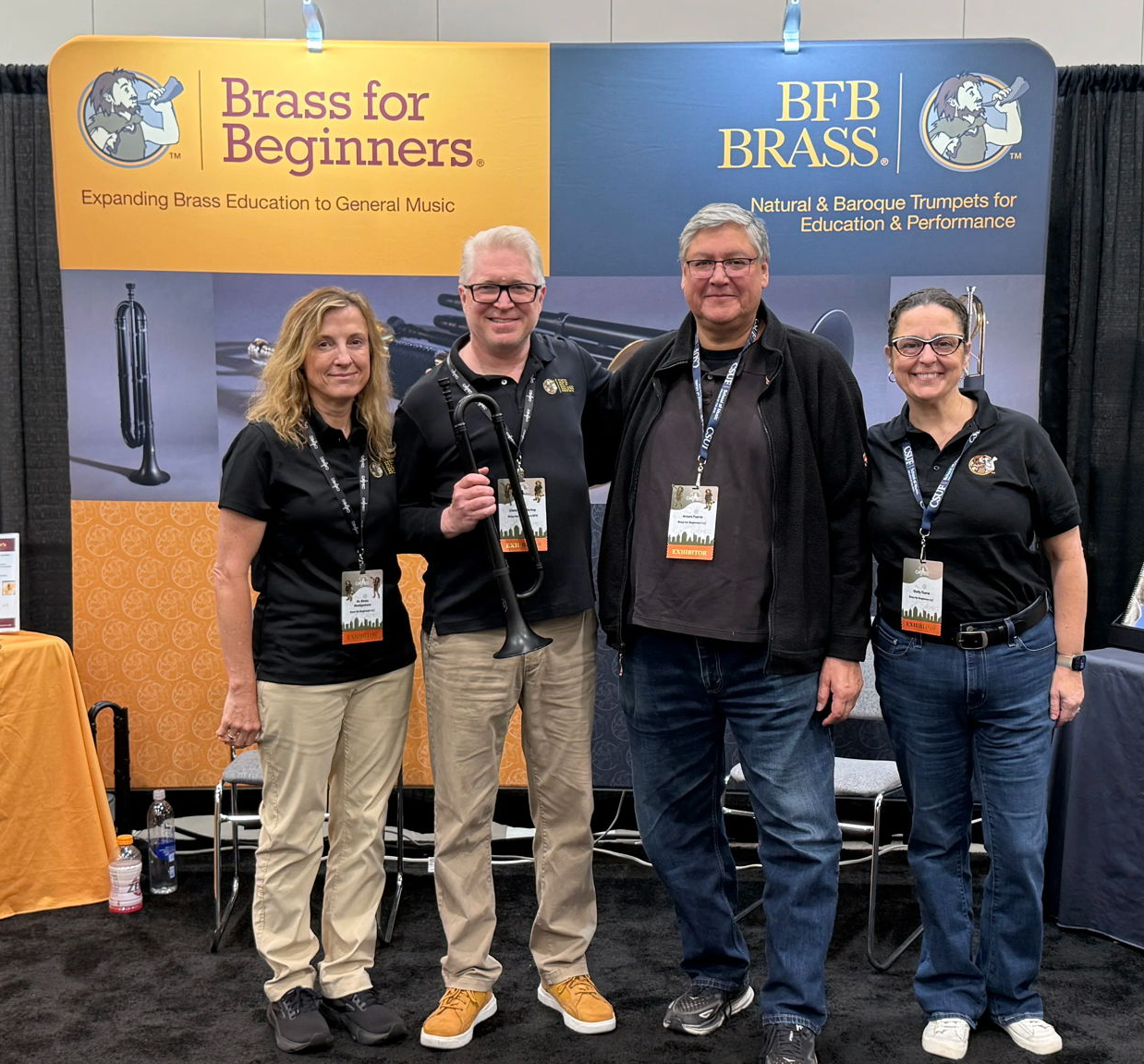
My co-presenters, who have been teaching Brass for Beginners in their own classrooms for several years, lead portions of the session. Rather than just talking about the program, they guide participants through it, giving a real sense of what it feels like—and sounds like—in a classroom setting.
Ultimately, the goal is to give teachers practical tools and a clear, firsthand understanding of how this approach can make brass instruction accessible, engaging, and meaningful for all students.